AI & automation
AI automation for Christian businesses
Your business should not depend on you moving information between tools all day. Kingdom Business builds AI agents, automations, and custom software around your actual workflows, helping your people serve customers with clarity while you steward the company God has entrusted to you.
Book a Strategy Call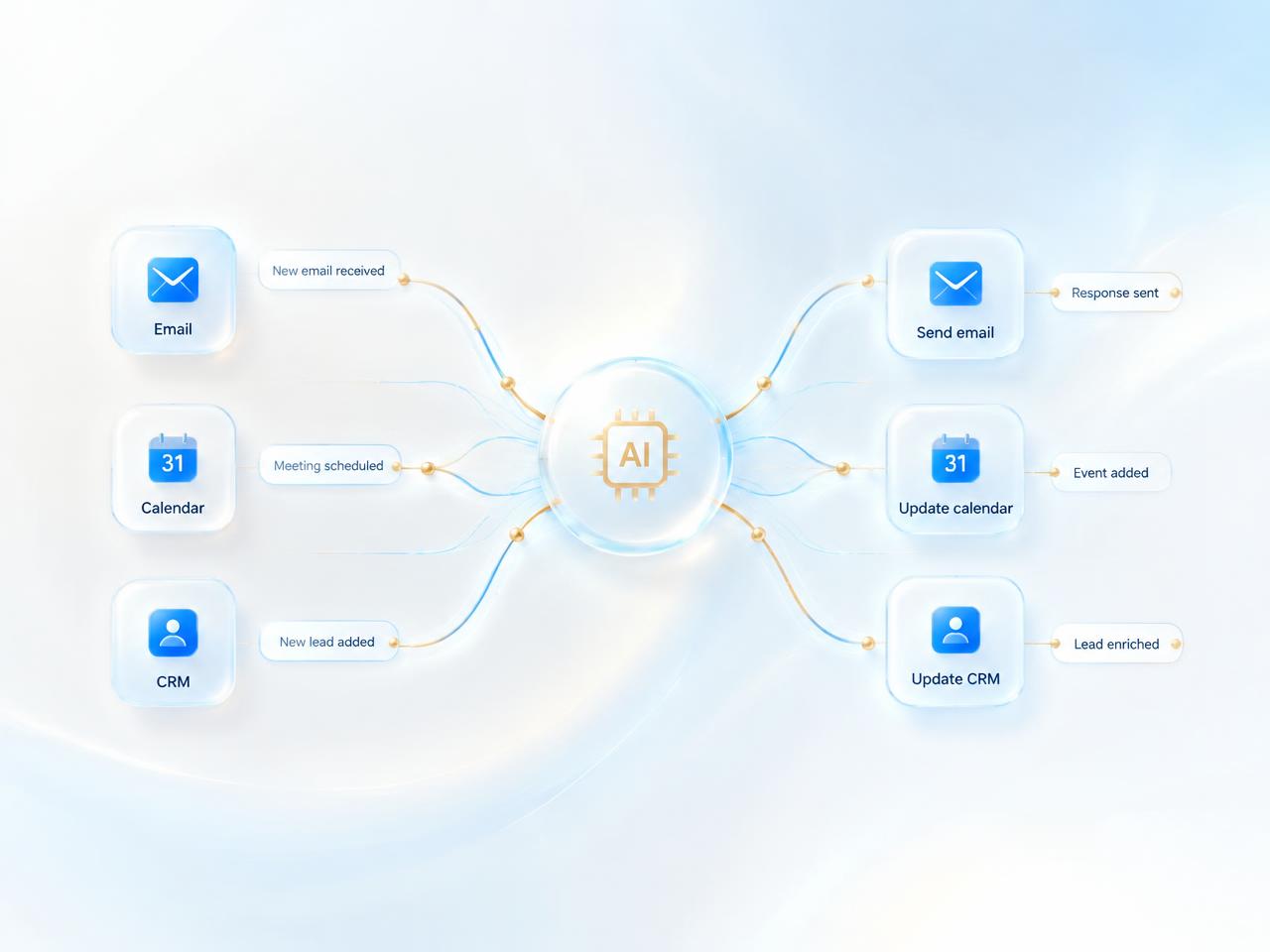
01
What AI automation means for your business
AI automation connects a useful intelligence layer to a repeatable business process. A traditional automation follows rules: when a lead arrives, create a record and notify an owner. An AI agent can help interpret an inquiry, prepare a response, or summarize a conversation before the next action happens. The purpose is not to put AI everywhere. It is to remove avoidable friction where a clear process and appropriate oversight already exist.
For a Christian business, the standard is faithful stewardship rather than technology for its own sake. An automated message should be truthful. Customer information should be handled responsibly. Your team should know when a person needs to step in. We begin with the work and the people it affects, then decide whether an AI agent, a simple integration, or a better internal tool is the appropriate solution.
02
Who this is for: teams carrying too much manual work
This service is relevant when sales, operations, or fulfillment repeatedly lose time at the handoffs. Perhaps inquiries arrive in several places, your team copies notes into the CRM, and follow-up depends on someone remembering. Perhaps a sale is closed but the delivery team receives an incomplete brief. Those are process problems first. Automation can support a clearer process, but it cannot replace the decision about who owns the next step.
You do not need to replace every tool to begin. Bring an example of a workflow that is frustrating your team, the systems involved, and the outcome you want to make more consistent. If the task requires sensitive judgment, relationship repair, or a decision that belongs to a leader, keeping that work human may be the right choice. A practical plan distinguishes between work that can be automated and work that should remain personal.
03
What we build across sales, operations, and fulfillment
Kingdom Business describes its work in terms of custom software, AI agents, and connected operating systems. These are not separate purchases to collect. They are building blocks that can be combined around a specific business need. The scope should make the handoff, the owner, the information required, and the exception path clear before implementation begins.
Sales agents and follow-up workflows
A sales workflow can connect incoming inquiries, CRM updates, follow-up preparation, and appointment scheduling. An agent can help organize information and draft useful responses while your team retains responsibility for the conversation. Define what qualifies a lead, what the system may say, and when a salesperson takes over. Clear boundaries matter more than making every interaction sound impressively automated.
Operations and fulfillment automations
Delivery workflows can carry agreed information from a sale into onboarding, task assignment, and progress updates. Instead of asking your people to reconstruct what was promised, the system can support a consistent handoff. Exceptions still need an owner. Missing information, unexpected customer requests, and failed integrations should become visible work rather than silently disappearing between applications.
Custom platforms and business visibility
When off-the-shelf tools leave gaps, a custom portal or internal dashboard can give your team a clearer place to work. The aim is useful visibility: what is waiting, who is responsible, and which customer needs attention. Custom software should support the workflow you choose, not introduce another screen everyone must update without understanding why it matters.
04
A practical process from bottleneck to working system
Start by tracing a real example from beginning to end. Where does the information enter? Who uses it next? What happens when it is incomplete? Write down the recurring steps and the decisions that require judgment. Then identify the smallest useful workflow to improve. This keeps the project grounded in operational reality rather than a broad promise to transform the whole company at once.
Next, define what success means for that workflow using your own baseline. You might track whether inquiries reach the right owner, whether onboarding information is complete, or whether staff still need to enter the same information twice. Choose measures your people can explain. During implementation, test normal cases and exceptions, review the outputs, and agree who will maintain the workflow when tools or business requirements change.
05
Build automation around EOS clarity
The Entrepreneurial Operating System, or EOS, gives leaders a language for vision, accountability, priorities, and execution. Technology can support that clarity through scorecards, rocks, to-dos, and issues in a connected workspace. An automation should have an accountable owner just as a business process does. A dashboard should answer a leadership question, not simply display every available metric.
When a workflow fails or a recurring exception appears, treat it as an issue to solve rather than adding another workaround indefinitely. Bring the underlying problem into your operating rhythm, decide on the change, and update the process and software together. The goal is a business that understands how its systems work and can improve them deliberately, with AI serving the mission rather than becoming a new source of dependence.
Client perspectives
Success stories from real systems work
These clients describe their own experiences with the team's sales and AI systems. Their accounts provide context for the work; they are not a forecast or a guarantee for another business.
“Running an AI sales acquisition team was costing us way more than it should and the results were all over the place. We'd been burned before so I was hesitant to trust another service. But Jay helped us build out an AI sales team that not only improved our appointments booked but saved us an estimated $240K per year. Better results AND massive cost savings. If you need to optimize your sales acquisition, this is the team.”
“Our fulfillment processes were eating us alive - costing time, money, and our sanity. We were struggling to keep up with client demands and knew something had to change. The team stepped in and worked with us to build AI agent systems that completely streamlined our fulfillment. We fixed issues on 15+ clients and saved $150K in revenue. Our clients are happier, our bottom line is better. If your fulfillment is broken, these guys are the fix.”
“We're a $6 million VC-backed company trying to compete with giants like Salesforce and Hubspot. We knew we needed a killer SDR system for appointment setting, but building that out felt overwhelming. I'll be honest - I had doubts about whether anyone could deliver at the level we needed. But Jay and the team didn't just meet our expectations, they blew past them. They built out a robust SDR system that's put us on the path to becoming a billion-dollar brand. If you're serious about scaling, this is the partner you need.”
Frequently asked questions
What is AI automation for Christian businesses?
It is the practical use of AI agents, connected workflows, and software to support business tasks while honoring truthful communication, responsible stewardship, and human accountability. The starting point is a real process problem, not a requirement to use AI in every part of the company.
Which business process should we automate first?
Start with a repeatable workflow that has a clear owner, reliable inputs, and a visible bottleneck. Lead follow-up, CRM updates, or onboarding handoffs may be useful candidates. Compare the potential benefit with the risk and keep decisions requiring sensitive judgment with a person.
Will AI agents replace our team?
Our focus is supporting your people with better systems. Agents can help with repeatable work and information handling, while people remain responsible for relationships, exceptions, and important decisions. The appropriate division of work depends on your process and the level of oversight it requires.
Can automation work with our existing software?
The first step is reviewing your current tools, available integration options, and data requirements. Some workflows can be connected without replacing the underlying applications; others may need custom software. Compatibility and scope should be confirmed before committing to a build.
How does AI automation support EOS?
Automation can support the processes behind an EOS scorecard, rocks, to-dos, and issue tracking. It works best when each workflow has an accountable owner and useful measures. Technology supports the operating rhythm; leaders still set priorities, review issues, and make decisions.
Explore connected services
Book a free strategy call
Talk through one workflow. No obligation.
Start with your business, not another tool
Bring one workflow that repeatedly pulls you away from leading. We can discuss how it operates today, what needs to remain human, and where custom software or AI could support your team. You do not need a finished technical specification to begin a practical conversation.
Book a Strategy Call